 Synthetix
 Synthetix collateral haircuts and margin capacity
Synthetix collateral supports perpetual positions through haircut-adjusted margin, so a non-USDT balance contributes less trading capacity than its raw market value. USDT counts at face value, while WETH contributes value after its applicable discount. Account profit or loss and existing margin requirements then affect how much remains available. The same non-USDT collateral can back USDT debt, which adds loan-to-value limits to the constraints on withdrawals and further trading.
Bottom line: Non-USDT collateral can support trading without becoming USDT cash, so margin capacity and withdrawable balances answer different questions.
Available margin before a new position
Insufficient available margin prevents opening or increasing a perpetual position, even when the subaccount holds collateral with a larger undiscounted market value.
Existing positions already consume part of the account’s margin capacity. The initial margin required for a position reflects its notional value and selected leverage, subject to the market’s applicable minimum. Maintenance margin governs the collateral needed to keep positions open. Collateral eligibility and market eligibility remain separate. Market configuration can impose position-size tiers, leverage limits, and a close-only status. Extra collateral cannot override a market restriction that prevents opening new exposure. These conditions also apply to orders submitted through an API.
Supported deposits and USDT settlement
The Ethereum Mainnet exchange supports USDT and WETH deposits into trading subaccounts, with both assets contributing to margin under different valuation rules. WETH means wrapped ETH; ETH also pays wallet gas for onchain collateral transactions. The deposit documentation distinguishes supported deposits from planned additions including cbBTC, sUSDe, and wstETH. A collateral configuration or planned asset listing does not establish that every deposit interface accepts that asset.
Trading fees, funding payments, and realized profit or loss settle in USDT. Keeping WETH as collateral therefore leaves settlement accounting in another asset. Older SNX-backed synth issuance used a different debt model. Synthetix retired the legacy 420 Pool staking system, ending its former staking mechanisms. Those historical collateral ratios do not describe exchange trading margin.
Equity, discounted value, and account capacity
Raw asset equity measures a token holding at its index price, while discounted collateral value determines the contribution that the holding makes to margin. Adjusted Account Value, or AAV, then incorporates the account’s collateral valuation and profit or loss.
Valuation of each asset
USDT face value
USDT contributes its face value to margin and provides the balance into which trading cash flows settle.
Non-USDT discounts
Supported non-USDT collateral contributes its haircut-adjusted value to margin. For a single discount without a tier addition, multiply token quantity by index price, then by one minus the haircut fraction. This calculation separates the asset’s market value from its recognized margin contribution. A tiered configuration can also include a value addition, so a simple percentage calculation does not describe every holding.
The subaccount total
Available Margin describes capacity for new positions after existing requirements consume part of adjusted account value. The account record separately reports initial margin, maintenance margin, unrealized profit or loss, and debt. The asset valuation explains how much backing enters the calculation; the account summary explains how much capacity remains after obligations.
Haircut tiers and live configuration
Haircut tiers depend on the value of an asset holding and can change the ratio that converts raw equity into recognized collateral. The public getCollaterals query exposes tier boundaries, value ratios, haircuts, and value additions, alongside deposit caps and loan-to-value thresholds. The valuation method is a rule; its applicable percentages and limits are configuration values. The balances display supplies the actual haircut breakdown for an account.
Collateral shared within one subaccount
Cross-margin combines the collateral backing positions inside one subaccount, while separate subaccounts maintain separate balances, debt, and risk. Profit on one position can support other positions in that same pool. Assets elsewhere under the wallet do not automatically replenish it. Internal transfers also face availability checks: the source must retain enough backing for its positions and debt constraints. API transfers require owner or manager authorization for both accounts, and trading delegates cannot initiate them.
Index prices and changing collateral capacity
Index prices value non-USDT collateral, so a price decline can reduce margin capacity without any change in token quantity or trading activity.
The discount applies to that changing valuation. Lower adjusted collateral can also raise the debt-to-collateral ratio when the debt amount stays unchanged. Available Margin and withdrawal capacity can therefore move while the asset balance appears constant. The price used to value collateral has a different purpose from the mark price used for position margining and unrealized profit or loss. A position’s liquidation estimate can change because its collateral loses value, because other positions change account profit or loss, or because settlement charges reduce USDT. Watching only the traded market’s last price misses changes in the backing account.
How does USDT debt change collateral limits?
USDT debt constrains non-USDT backing when the USDT deficit exceeds positive unrealized profit.
Trading fees, funding payments, and realized losses can reduce USDT while the account continues to hold other collateral. Positive unrealized profit may temporarily cover that deficit. Its ability to offset the balance changes with the open positions’ profit or loss.
The Borrowing tab distinguishes the borrowed amount from available borrowing capacity, accrued interest, and the maximum borrowing limit. Interest adds another amount to track while debt remains outstanding. Its displayed hourly rate is a changing input, rather than a permanent collateral specification.
The app’s voluntary Swap converts supported non-USDT collateral into USDT when effective debt exists. The quote shows the estimated USDT received after the exchange fee. Conversion changes the source token quantity and the USDT balance; margin credit from a deposit does not itself perform this conversion.
The voluntary exchange must leave enough margin after execution and requires sufficient source collateral to cover its fee. Its execution price determines the source amount needed for the requested USDT. Repayment can release a debt-related withdrawal constraint, while outstanding positions can continue to require collateral. Closing positions does not automatically repay remaining USDT debt.
Debt ceilings and maintenance requirements
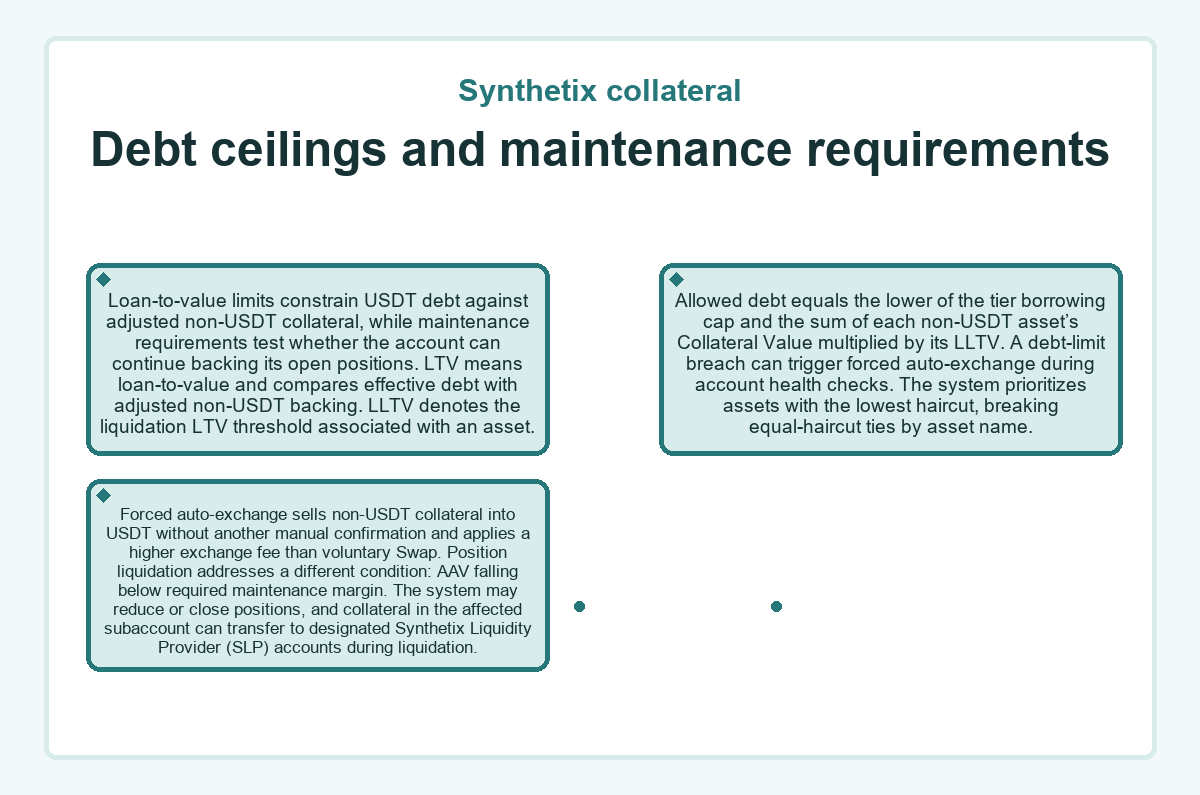
Loan-to-value limits constrain USDT debt against adjusted non-USDT collateral, while maintenance requirements test whether the account can continue backing its open positions. LTV means loan-to-value and compares effective debt with adjusted non-USDT backing. LLTV denotes the liquidation LTV threshold associated with an asset. Allowed debt equals the lower of the tier borrowing cap and the sum of each non-USDT asset’s Collateral Value multiplied by its LLTV. A debt-limit breach can trigger forced auto-exchange during account health checks. The system prioritizes assets with the lowest haircut, breaking equal-haircut ties by asset name.
Forced auto-exchange sells non-USDT collateral into USDT without another manual confirmation and applies a higher exchange fee than voluntary Swap. Position liquidation addresses a different condition: AAV falling below required maintenance margin. The system may reduce or close positions, and collateral in the affected subaccount can transfer to designated Synthetix Liquidity Provider (SLP) accounts during liquidation.
A rejected order with sufficient raw equity
A smaller order can resolve a margin shortfall when its assessed requirement fits the account’s discounted capacity and all other trading constraints remain satisfied. In this hypothetical account, supported non-USDT collateral has raw equity of 1,734 USDT and a single 9% haircut. Assume no tier addition, initial USDT balance, existing positions, reservations, or unrealized profit or loss.
The discounted contribution is 1,734 multiplied by 0.91, or 1,577.94 USDT. An order requiring 1,604 USDT of initial margin exceeds that capacity by 26.06 USDT before fees. Raw equity suggests that the order fits; the observed margin figure explains an insufficient-margin rejection. The submitted order does not open a position in this case.
Before retrying, the trader reduces the proposed size until its assessed initial margin is 1,534 USDT. Assume the revised order fills, its trading fee is 2.84 USDT, prices stay unchanged, unrealized profit or loss remains zero, no other balance changes occur, and borrowing limits permit the resulting deficit. Adjusted value after the fee is 1,575.10 USDT. Subtracting the position’s initial margin leaves 41.10 USDT of available margin.
The account now shows an open position using 1,534 USDT of margin and a USDT balance of -2.84. With no positive unrealized profit, that balance represents debt. The smaller request changed the required backing; it did not change the haircut rule. A later price or parameter change would require another margin calculation, and the remaining capacity is not a universal withdrawal allowance.
Withdrawal capacity and collateral records
Withdrawal capacity applies asset-specific balance and debt checks in addition to the account’s margin budget, so spare trading margin does not establish a transferable token amount. USDT withdrawals also face a USDT cap. Positive unrealized profit can support that cap, while discounted non-USDT backing does not automatically become USDT available to send.
The getWithdrawableAmounts response distinguishes each asset’s quantity from its withdrawable amount and pending withdrawal reservation. Its account-level USDT-denominated budget is independent of the requested asset list. Adding the per-asset amounts together would mix token units and would not reproduce that budget. For non-USDT collateral, availability must preserve the backing required for effective USDT debt.
Collateral history records deposits, withdrawals, and internal transfers with pending, successful, or failed status. It excludes funding payments, which have separate records. An onchain deposit receipt establishes the blockchain outcome, while account indexing supplies the credited account record. Withdrawal fees reduce the amount received, and wallet gas remains separate. Collateral that supports ongoing positions or debt can remain unavailable even when the token quantity is positive.
Everyday questions about Synthetix collateral
Does Synthetix charge the margin haircut on every new order?
Collateral haircuts discount margin value, while filled orders incur separate trading fees. The valuation discount does not create another token deduction each time an order fills. Trading fees settle in USDT and depend on the executed notional amount and applicable fee rate.
Why can Swap be unavailable despite a negative USDT balance?
Swap can be unavailable when positive unrealized profit fully offsets a negative USDT balance. The app’s repayment flow requires effective USDT debt. Changes in the open positions’ profit or loss can change eligibility without altering the displayed USDT balance.
Is the Swap fee always equal to my collateral valuation discount?
The voluntary Swap fee uses the source asset’s lowest-tier haircut. Collateral valuation can apply the tier appropriate to the holding, so its discount can differ. The quote includes the exchange fee in the estimated USDT received.
Can I withdraw WETH without first converting it to USDT?
WETH withdrawals can return WETH directly to the destination wallet when the asset is withdrawable. The withdrawal fee is denominated in WETH. The wallet separately pays Ethereum Mainnet gas in ETH; conversion into USDT is a separate collateral operation.
What happens if a collateral asset has no configured withdrawal fee?
The API treats collateral without a configured withdrawal fee as unavailable for withdrawal. getWithdrawableAmounts returns zero for that asset’s withdrawableAmount and withdrawFee, while it can still report quantity and pendingWithdraw. Missing fee configuration does not mean that withdrawals are free.
How does the API’s collateralValue field differ from the app’s Collateral Value?
The getSubAccount field collateralValue reports full asset value before the haircut; adjustedCollateralValue reports its discounted USD-equivalent value. The app’s Collateral Value label describes the discounted margin contribution. The matching word in the API field name therefore identifies a different valuation.
How many decimal places may a collateral withdrawal use?
Collateral withdrawal amounts must respect the selected asset’s QuantityPrecision. The getAssets query supplies that setting for the requested asset. Excess decimal places can cause rejection despite sufficient margin. The submitted amount must also remain positive.